What is Metacognition?
Metacognition means “thinking about one’s own thinking”, “higher –order cognition about cognition”, “knowledge about knowledge”, “thoughts about thoughts” or “reflection about reflection”
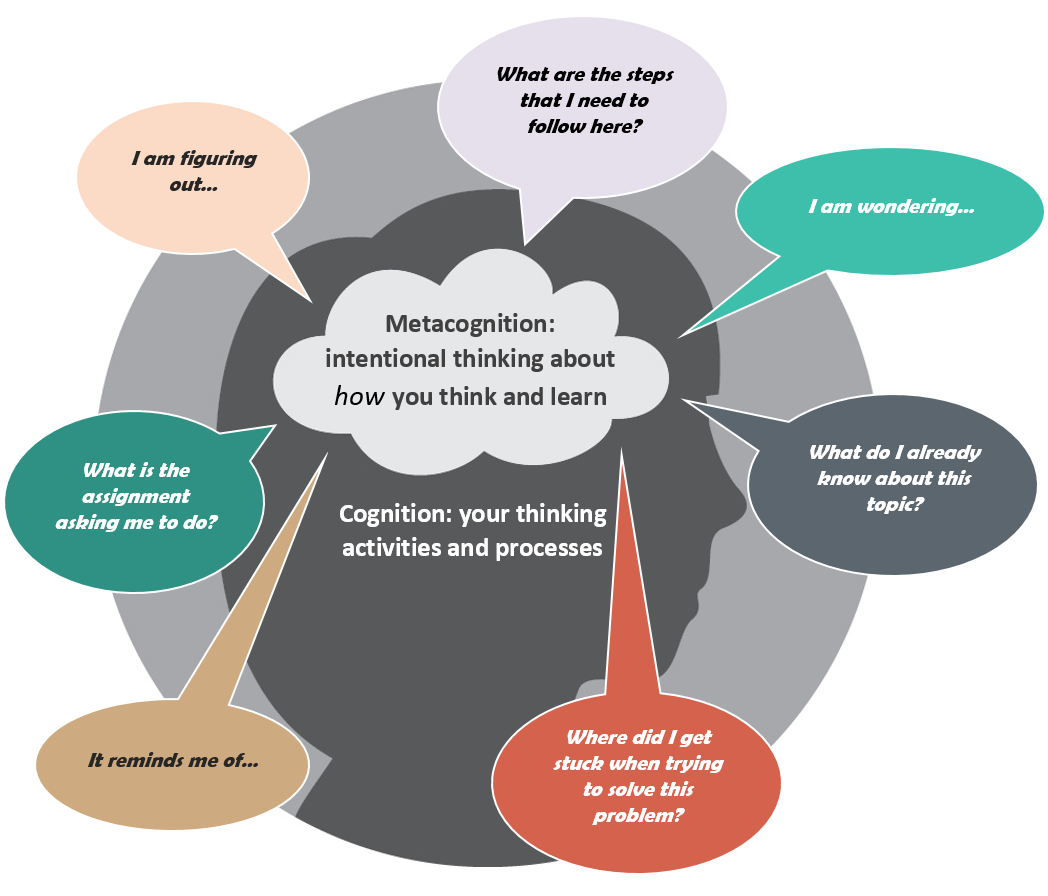
Metacognitive Strategies list
Here is a list of the Metacognitive strategies:
1. Think Aloud
2. Practice your syllabus as a roadmap
3. Summon your prior knowledge
4. Figure out how you learn best
5. Test yourself
6. Review your exams
7. Organize your thoughts by Concept Mapping
8. Querying self-reflective questions
9. Beckon your prior knowledge
10. Substitute Self-reflection
11. Endorse Self-directed Learning.
12. Deliver Opportunities for Assemble Errors.
13. Resolve Problems with a Team
14. Explain Strategies Directly
15. Pre-assessment (Self-Assessment) of Content
Metacognitive Strategies to Improve Learning:
Rosier (2017) gave seven methods to advance the Metacognition:
1. Clarify students however their brains are bolstered for development and growth
The beliefs that students adopt regarding learning and their own brains will have control over their performance. The analysis shows that after students develop a growth knowledge vs. a tough and quick mindset, they’re plenty of ostensibly to possess interaction in reflective puzzling over but they learn and grow. Teaching kids concerning the science of metacognition are going to be AN empowering tool, serving to students to understand but they’re going to just about growing their own brains.
2. Provide students to observe recognizing what they don’t perceive
3. Give opportunities to students to imitate on schoolwork Higher-order thinking skills are nurtured into the scholars. Students are ready to cram and to spot their own psychological feature growth. Queries that facilitate this progression could be comprised of: Before this course, I believed earthquakes were caused incidentally. Currently, I perceive that they’re being resulted from a kid.
4. Partake students preserve academic journals
One way to assist students to monitor their own thinking is thru the observe of individual learning journals. portion them tabloid queries that facilitate students to mirror on however instead of what they learned. queries would possibly include:
- What was calmest on behalf of me to find out this week? Why?
- What was most challenging on behalf of me to learn? Why?
- What study methods worked well as I ready for my exam?
- What didn’t methods for communicating preparation work well? what’s going to I do otherwise next time?
- What study habits worked best for me? How?
- What study habit can I attempt or improve upon next week?
Reassure creative expression through no matter journal shows work best for learners, including mind maps, blogs, wikis, diaries, lists, e-tools, etc.
5. Observe a “wrapper” to surge students’ watching assistances or skills A “wrapper” could be a short intercession that surrounds a current activity and assimilates a metacognitive practice. Beforehand a lecture, as an example, provides a few tips regarding active listening. Succeeding the lecture, raise students to write down 3 key philosophies from the lecture. Afterward, share what you believe to be the 3 key concepts and raise students to self-check however closely theirs matched your proposed goals.
6. Think about essay vs. multiple-choice exams: Research shows that students use lower-level thinking skills to rearrange for multiple-choice exams, and higher-level metacognitive skills to arrange for essay exams. whereas it’s less time intensive to grade multiple-choice queries, even the addition of the many short essay queries can improve the approach students replicate on their learning to arrange for check taking.
7. Ease the reflexive thinking: Reflexivity is that the method of turning into tuned in to our biases — preconceptions that get within the approach of the healthy development of mind. academics will build a schoolroom culture for a lot of profound learning and reflexivity by encouraging dialogue that encounters human and social group biases. once students have interaction in conversations or write essays on biases and ethical predicaments associated with politics, wealth, racism, poverty, justice, liberty, etc., they learn to “think regarding their own thinking.
 Biologist